

 Sandrina Rodrigues
And another month has passed! This month of November was a typical winter month, with a predominant north wind, very cold in São Miguel, poor visibility due to fog and a lot of swell, allowing us to go to the sea only 9 days.

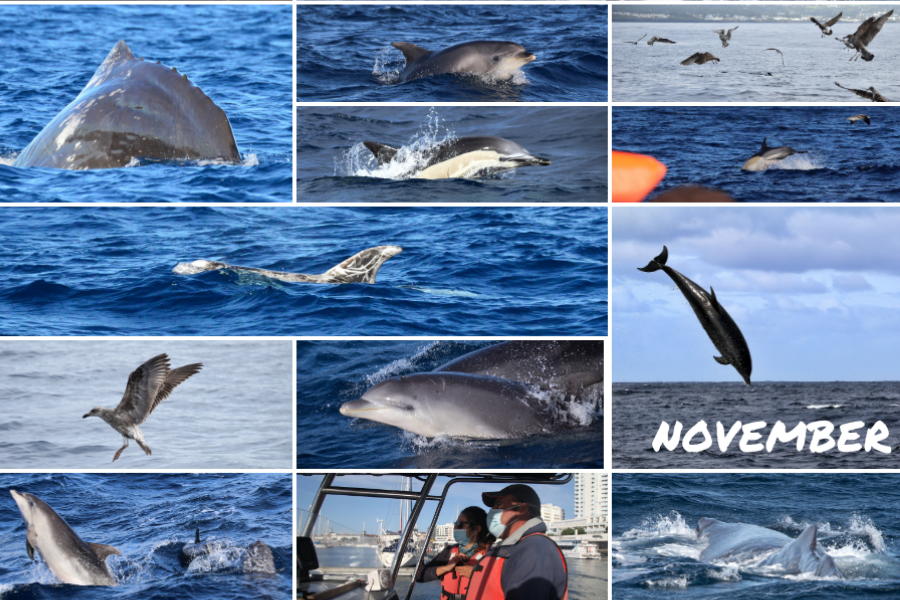
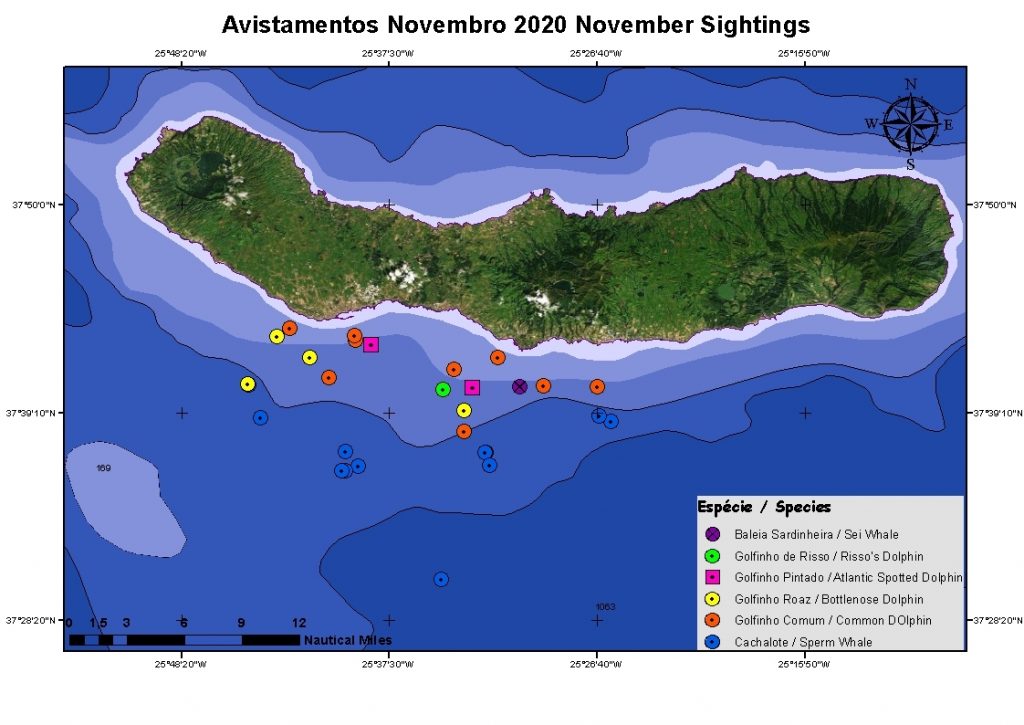
In November, 6 species of cetaceans were sighted: the common dolphins (Delphinus delphis) were the most sighted species (7 days) with large groups and close to the coast and we were able to observe several times, these animals feeding of needlefish together with seagulls.
The bottlenose dolphins (Tursiops truncatus) were spotted in 4 days and this month they were very active, performing acrobatics out of the water and we saw the same group twice with about 60 individuals (with very small calves).
The Atlantic spotted dolphins (Stenella frontalis) were sighted for 3 days, and we even could see them feeding together among common dolphins. However since the sea temperature is decreasing, it is expected that these animals leave the Azores, heading south to remain the winter in warmer waters.
The Risso´s dolphins (Grampus griseus) were spotted once, but it was a very important sighting for our photo-identification catalog! We were able to observe our well-known group of resident females who had not been seen for a long time.
Two sei whales (Balaenoptera borealis) mother and calf pair were also sighted once, very close to the coast, but unfortunately due to the sea conditions and the behavior of these animals, the observation was quite complicated! The animals were swimming randomly, making 10 minutes dives and moving a long distance underwater, so we could only observe one surface, but there was no doubt that it was this species of baleen whale.
The Sperm whales (Physeter macrocephalus) were observed on 5 different days! We had encounters with groups of females with newborns and with two different males, the famous Mr. Liable and the new cataloged male, Mr. November! In addition to photographing the tails, we could also record the clicks made by these animals during the feeding dive, in order to estimate their real size!
We were also able to observe a loggerhead sea turtle (Caretta caretta) and Portuguese man-o-war (Physalis physalis).
November is marked as the month in which the Cory’s shearwaters (Calonectris borealis) start to leave the Azores, although we still see a big number of Great shearwaters (Ardenna gravis), the number of birds has significantly decreased, which proves that they will make their migration, heading south, returning to the Azores during the spring.
December has already arrived and we look forward for the next trips to see what surprises the Azorean sea holds for Christmas! Stay safe and tuned!

 Futurismo Biologists Team

 Futurismo Biologists Team

 Sandrina Rodrigues
