

 Sandrina Rodrigues
Do you know what unexploded ordnances (UXOs) are? Can you imagine the risk that these impose to marine biodiversity?
Unexploded ordnances are explosive munitions, such as bombs, grenades and mines, which have not yet been set off, and therefore still pose a risk of detonation. Several conventional ammunitions have been discarded in our oceans after World War I and II, a ‘quick and dirty’ way of getting rid of surplus material and problematic waste. These present a risk not only to human lives, but also to the environment and its biodiversity.
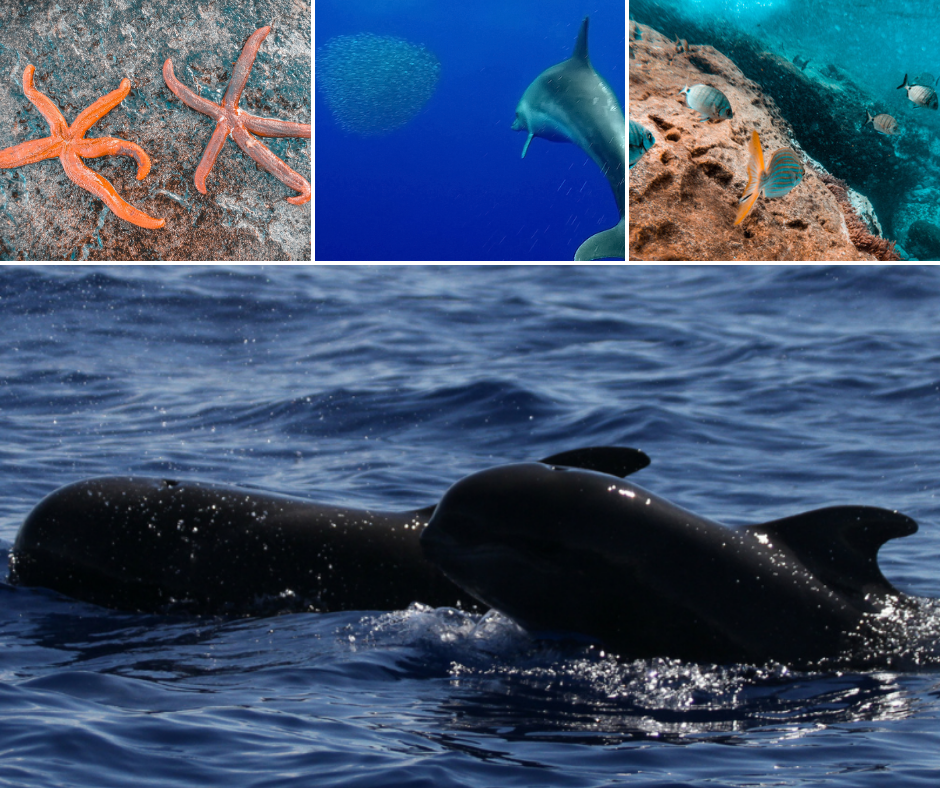
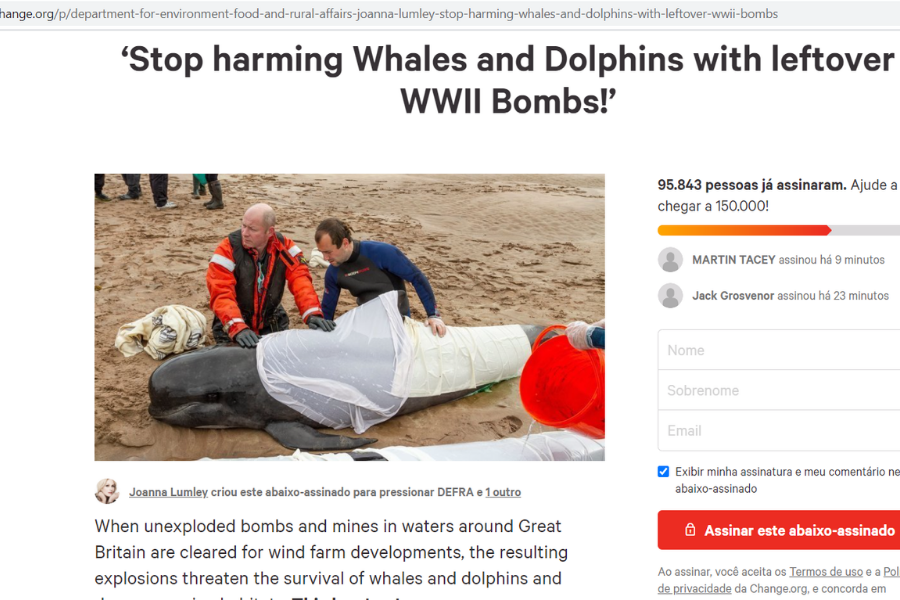
While exploding, UXO produce high amplitude shock pulses that consequently create a series of positive and negative pressure changes, as well sound waves that can cause injury and/or lead to the death of marine vertebrates and invertebrates. An example of this is the Kyle of Durness (Scotland) incident from 2011, where after a controlled detonation of a series of bombs caused a group of 35 pilot whales to strand on a beach, of which 20 ended up dying. The impact on the marine environment depends on diverse set of factors such as the pressure level at the source, sound/energy radiation in the water, type of sea floor and specific thresholds for noise exposure.
Thus, what to do with these ammunitions? – There are three options:
1) leave it in place;
2) detonate it in-situ;
3) remove it to a place prior to detonation.
Due to its instability, underwater UXO usually needs to be disposed in-situ. The traditional disposal of underwater UXO is done by placing a counter charge next to it and detonating it. This, has several consequences on cetaceans, as even if mitigation measures are taken into account, like clearing the area with an 1 km radius, the traditional disposal of underwater UXO can have effects up to 25 km and therefore impact cetaceans navigation system, communications, feeding patterns, among others.
While traditional methods are still the most used method of UXO disposal, other procedures are now emerging on the market that present safer ways for the environment. An example of that is EODEX – munitions specialists, that uses a ‘Low Order’ technique. EODEX places a counter charge next to the UXO, that fires a small magnesium cone into it and causes the explosive contents to ‘burn out’ – NO EXPLOSION! This method has shown that can be several hundred times quieter and therefore exponentially reduce the impact on marine biodiversity.
A cause supported by the World Cetacean Alliance.
Want to know more?
See this YouTube video demonstrating the difference between both methods: https://youtu.be/jlxFkgcJ6BA
And this of EODEX explaining its method: https://www.youtube.com/watch?v=JtU1qpyHIVo
Written by Mafalda Navas
References:
EODEX (2020) EODEX – munitions specialists. https://www.eodex.co.uk/
Koschinski, S. & Kock, K.H. (2015) Underwater Unexploded Ordnance – Methods for a Cetacean-friendly Removal of Explosives as Alternatives to Blasting. ASCOBANS, 1-13.
von Benda-Beckmann, A.M., Aarts, G., Sertlek, H.O., Lucke, K., Verboom, W.C., Kastelein, R.A., et al. (2015) Assessing the Impact of Underwater Clearance of Unexploded Ordnance on Harbour Porpoises (Phocoena phocoena) in the Southern North Sea. Aquatic Mammal, 41(4), 503-523.


 Futurismo Biologists Team


 Sandrina Rodrigues
