

 Futurismo Biologists Team
Do you know how many species of whales and dolphins are in risk of extinction in the Azores?
This question is not easy to answer at all, but the International Union for Conservation of Nature (IUCN) has established a worldwide method to assess the conservation status of wildlife species. Since 2000, it has been widely recognized internationally the global Red List of Threatened Species, where the species are catalogued according to their extinction risk.
Together, the categories CRITICALLY ENDANGERED (CR), ENDANGERED (EN) and VULNERABLE (VU) are described as ‘threatened’.

In the Azores, 28 different species of cetaceans have been sighted so far. Did you know that 5 of them are listed in the three “THREATENED” categories? And 4 out of these 5, are the most sighted whale species in the archipelago: sperm whale, fin whale, blue whale and sei whale.
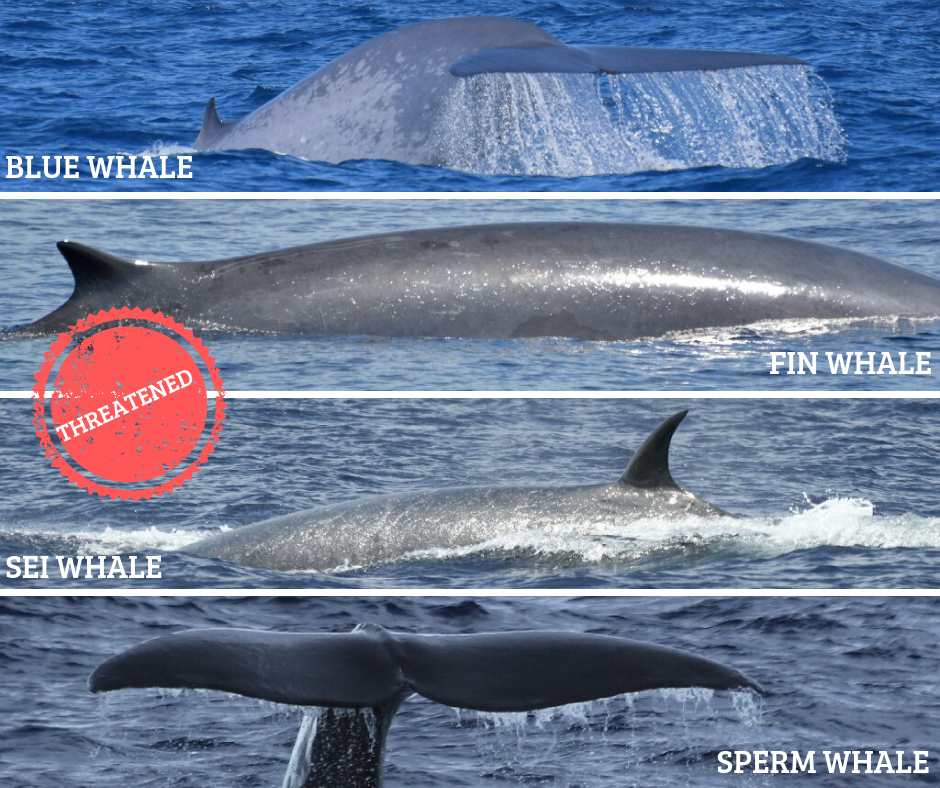
Sperm whales are sighted year-round around these islands and are categorised as Vulnerable (VU-A1d). That means that its population size has been reduced in at least 50% during the last three generations, and the causes of the reduction (i.e. commercial whaling) are clearly reversible AND understood AND ceased nowadays.
Baleen whales are sighted every year mostly in spring. Fin whales have been upgraded last year (2018) to Vulnerable (VU-A1d, the same as sperm whale). However, blue whales and sei whales are still categorised both as Endangered (EN-A1abd). That means that its population size has been reduced in at least 70% during the last three generations, and the causes of the reduction (i.e. commercial whaling) are clearly reversible AND understood AND ceased nowadays.
Having endangered animals on sight sums up value to our whale watching tours. But if you considered furthermore that other 13 species of cetaceans sighted in the Azores are listed as Data Deficient, our little Atlantic paradise becomes even more important. These means that there is inadequate information to make an appropriate assessment of its risk of extinction, i.e. more information is required. Among those Data Deficient species, we have pilot whale, false killer whale, killer whale, Bryde’s whale and most of the beaked whale species sighted in the Azores. As you can see, all of them have been sighted on our whale watching tours of the last few years.

Within this context, whale watching tours become a highly valuable source of cetacean data in the Azores, and worldwide! Going out to the sea year-round and recording data on every tour, give us the opportunity to collect useful (and long-term!) information to improve our knowledge about the species of whales and dolphins sighted in our waters. So… we will keep on collecting data on our tours! Will you join us?
Article by Laura Gonzalez, marine biologist at Futurismo
BIBLIOGRAPHY
- IUCN. (2012). IUCN Red List Categories and Criteria: Version 3.1. Second edition. Gland, Switzerland and Cambridge, UK: IUCN. iv + 32pp. ISBN. 978-2-8317-1435-6.
- Taylor, B.L., Baird, R., Barlow, J., Dawson, S.M., Ford, J., Mead, J.G., Notarbartolo di Sciara, G., Wade, P. & Pitman, R.L. 2008. Physeter macrocephalus. The IUCN Red List of Threatened Species 2008: e.T41755A10554884. http://dx.doi.org/10.2305/IUCN.UK.2008.RLTS.T41755A10554884.en. Downloaded on 15 May 2019.
- Cooke, J.G. 2018. Balaenoptera physalus. The IUCN Red List of Threatened Species2018: e.T2478A50349982. http://dx.doi.org/10.2305/IUCN.UK.2018-2.RLTS.T2478A50349982.en. Downloaded on 15 May 2019.
- Cooke, J.G. 2018. Balaenoptera borealis. The IUCN Red List of Threatened Species2018: e.T2475A130482064. http://dx.doi.org/10.2305/IUCN.UK.2018-2.RLTS.T2475A130482064.en. Downloaded on 15 May 2019.
- Cooke, J.G. 2018. Balaenoptera musculus. The IUCN Red List of Threatened Species2018: e.T2477A50226195. http://dx.doi.org/10.2305/IUCN.UK.2018-2.RLTS.T2477A50226195.en. Downloaded on 15 May 2019


 Futurismo Biologists Team


 Sandrina Rodrigues
