

Q: What kind of whales and dolphins can I see in the Azores?
In the Azores at least 25 species of cetaceans (whales and dolphins) can be seen. Four of these are considered to be resident, meaning we can see them year-round (sperm whale, common dolphin, bottlenose dolphin and Risso’s dolphin), others are seasonal or migratory and sighted only certain times of the year (blue whale, fin whale, sei whale, humpback whale, minke whale, Atlantic spotted dolphin, striped dolphin, short and long finned pilot whales), while the rest are rare visitors (beaked whales, orca, false orca, Bryde’s whale, pygmy and dwarf sperm whale, rough-toothed dolphin).
Click HERE to see a more detailed description of the cetaceans of the Azores
Our sightings vary a lot throughout the year due to seasonal movements of several species.
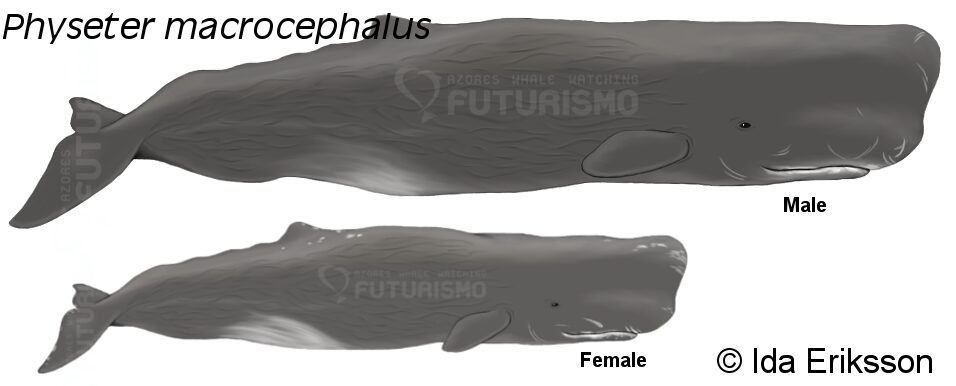 The whale species most sighted throughout the year is the sperm whale (Physeter macrocephalus) as it is resident here and can therefore be sighted year-round. However, in the spring time we commonly see fin whales, sei whales and blue whales. Several species of dolphin are also commonly seen: common dolphin, bottlenose dolphin, Atlantic spotted dolphin, pilot whales, Risso’s dolphin and striped dolphin.
It is extremely rare to see orcas (also known as killer whales), false killer whales, pygmy sperm whales and dwarf sperm whales. Beaked whales (6 different species) are registered in Azorean waters on a fairly regular basis, although they are difficult to watch because of their typical shy and elusive behaviour.
Q: When is the best time of the year to go whale watching in the Azores?
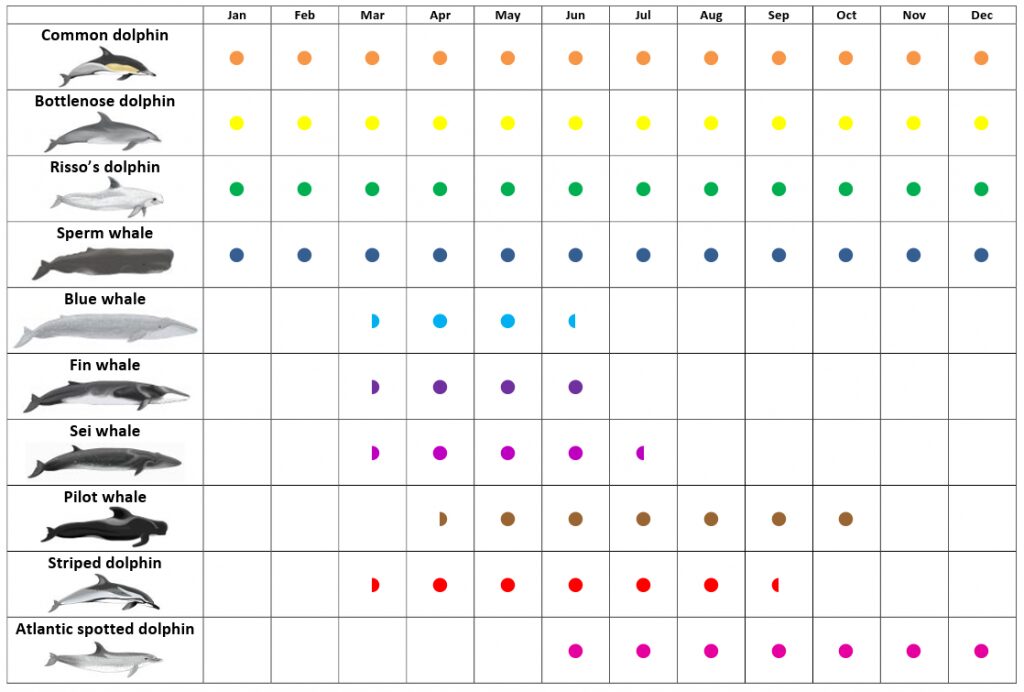
In the Azores whale watching is possible all year due to the year-round presence of four resident species (sperm whale, bottlenose dolphin, common dolphin and Risso’s dolphin). However, you have the best chance to see many species from March to October. Within this time period different species can be sighted so the time you choose to visit depends on what you prefer to see. For example, the summer months are the best for seeing groups of sperm whales as well as large groups of dolphins (sometimes groups of hundreds to thousands can be seen). The summer is also the best time to go swimming with the dolphins. For those people more interested in seeing large whales, the best time of the year is the spring. From about mid March to mid May many baleen whales (mostly fin whales, sei whales and blue whales) pass the Azores on their annual migration to their northern feeding grounds.
The following table is a guide to show roughly which months our most commonly sighted species appear each year in the Azores. There are variations from year to year, for example the season of the baleen whales (mostly blue whales, fin whales and sei whales) can begin earlier or extend into the beginning of the summer months. To see our sighting statistics in more detail click HERE.
Unfortunately for the orca lovers, this species is rarely sighted around the Azores. We do have orcas visiting us occasionally, but they prefer the deeper waters to hunt the sperm whale calves around Azores. There is no particular time of the year to observe orcas in the Azores, they can turn up at any time!
Click HERE to read about Futurismo’s last orca sighting off the coast of São Miguel island on the 24th of May 2013.
Q: Do you use sonar to find the whales?
No, we don’t use sonar because many whales and dolphins are very sensitive to noise as they use sounds themselves to communicate, navigate and locate their prey. Loud underwater sounds can cause them stress, confusion and hearing damage which can eventually lead to stranding and death. Instead of sonar we use VIGIAS (lookout men with powerfull binoculars) to locate the animals from shore, a passive yet very effective way of locating whales and dolphins without disturbing them.
Q: What is your tour success rate?
On 98-99% of all our tours throughout the year we encounter dolphins and/or whales! The best thing about the Azores is the great diversity of many species, so there is always an extremely high chance that you will see at least one type of whale or dolphin. On average we encounter 2-3 different species per tour, and at times we have even sighted 6 different whale and dolphin species in just one tour!
Click HERE to see our sighting statistics in more detail.
Q: What happens if I don’t see anything during my tour?
Cetaceans are wild animals that are always on the move; we do not train them, we do not feed them and we cannot control sea and weather conditions. Therefore, on rare occasions we do not see anything during the tour. However, if neither a dolphin nor whale species is sighted Futurismo will offer you another tour free of charge!
In the Azores we mostly swim with common dolphins, Atlantic spotted dolphins and bottlenose dolphins. Occasionally it is also possible to swim with the more shy Risso’s dolphins. See the first question for links to read more about the species.
No. All of the dolphins in the Azores are completely wild and we are just visitors that must respect them in their environment. Dolphins have sensitive skin and for them touch is a very important and often intimate sense that they use to communicate with each other. They do not touch us and in return we do not touch them. Most of the time the dolphins pass us in the water while sometimes taking more interest and swimming a few circles around us before moving on.
Q: Can the dolphins attack during a swimming tour?
Dolphins are wild predators with a heavy body and a mouth full of sharp teeth. But there has never been any unprovoked attacks from wild dolphins. Dolphins have a well deserved reputation of being very friendly. As long as you let the dolphins come to you and you just stay still and calm in the water you will be fine and have a great experience.
No, swimming with whales is forbidden in the Azores. A special permit is required for everybody wanting to enter the water for research or underwater photography.
Q: Don’t the dolphins get injured by the propellers?
This is very rare and we have never had any problems because dolphins are very intelligent animals and of course we drive carefully around them and never chase after them. The dolphins actually like to approach us and play with the bubbles coming out the back of the boat!
You can see spotted dolphins checking out the propeller from one of our zodiacs in the video below.
They were hunting sperm whales until 1986 and have since completely switched over to whale watching. The last sperm whale was killed in 1987 off the coast of Pico island. Futurismo is one of the pioneers in whale watching both in São Miguel and Pico islands.
Whales can reach between 20 to 100 years of age. There is a wide range between species (there are about 100 species and subspecies) but the average life expectancy is about 50-70 years for whales and 20-60 years for dolphins (fairly wide range but it includes about 37 species, some which aren’t longer then 2 meter and others gets up to 7-8 meters, a simple rule: the bigger the older).
Sperm whales can live for at least 70-80 years. It is possible that they can live longer than this, but more research is required.
18 months (the longest of all cetaceans).

 Futurismo Biologists Team
 Sandrina Rodrigues
