

 Futurismo Biologists Team
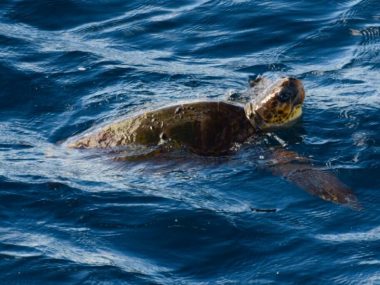
Chelonia mydas | Green turtle
Green turtles are the second largest sea turtle species, after leatherback turtles. Their name comes from the green colour of the fat beneath of their shell. She can grow up to 1.66 m in length and weigh up to 200 kg. Unlike the Kemp’s ridley sea turtle, the muzzle is very short and the beak is not hooked. Green turtles have a serrated jaw which facilitates feeding (they are principally herbivorous).Green turtles reach sexual maturity after 20 to 50 years and live up to 80 years. Like other turtles they migrate long distances between feeding areas and incubation beaches. Mature females and males arrive at intervals of two years to make their nests on the same beaches on which they were born. This occurs between June and September. are usually found in coastal waters with much vegetation, such as Islands and sheltered bays. Overall distribution is throughout tropical and subtropical seas, with two distinct populations; one in the Atlantic Ocean and one in the Pacific Ocean. In the Azores, their incidence is occasional.
Length:
• Total: Up to 120 cm
• Carapace: 71 – 139 cm
Weight: 150 kg
Global population: c.60,000
Status: Endangered
Diet: The green turtle is herbivorous and feeds on seaweed and macroalgae (Caulerpa, Turbinaria, Spyridia, Codium and Ulva)
Longevity: 80 years
Breeding age: 20 – 50 years
Number of eggs: 38 – 195 eggs
Incubation: 45 – 60 days
In other languages
Portuguese: Tartaruga verde
Spanish: Tortuga verde
French: Tortue verte
Italian: Tartaruga verde
German: Suppenschildkröte
Dutch: Soepschildpad
Swedish: Grön havssköldspadda
Norwegian: Suppeskilpadde
Danish: Suppeskildpadde/ Grüne Meeresschildkröte
Finnish: Liemikilpikonna
Polish: Żółw zielony, żółw jadalny


 Futurismo Biologists Team

 Sandrina Rodrigues
