

 Futurismo Biologists Team
Lepidochelys kempii | Kemp’s ridley turtle
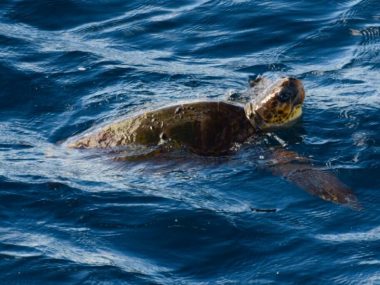
The Kemp’s ridley turle is the smallest and rarest sea turtle. They are greyish-green in colour, with the colouration changing as they age. Young individuals are almost completely dark grey to black, whereas adults have a yellowish green or white plastron (ventral part of the shell) and a grey to green shell. Kemp’s ridley turtles feed on molluscs, crustaceans, jellyfish, algae, seaweed and sea urchins. They are considered to have the most restricted range of all sea turtles. Adults are found scattered almost exclusively throughout the Gulf of Mexico. Young and sub-adults are mostly seen along the whole coastline of the tropical western Atlantic, but they are also occasionally carried away by the Gulf Stream to Newfoundland in Canada, or to the coasts of Europe and North Africa. Kemp’s ridley turtles prefer shallow water habitats with muddy and sandy bottoms. During nesting all the females dig their nests in Mexico, with 95% of these nests occuring in a beach at Rancho Nuevo during the period of April to August.
Length:
• Up to 70 cm
• Carapace: 72 cm
Weight: Up to 38 kg
Global population: c.1,000 females at reproductive age
Status: Critically Endangered
Diet: Molluscs, Crustaceans, jellyfish, algae or seaweed and sea urchins
Longevity: 30 – 60 years
Breeding age: 20 – 50 years
Number of eggs: c. 100
Incubation: 45 – 60 days
In other languages
Spanish: Tortuga bastarda, tortuga golfina
French: Tortue de Kemp, Ridley de Kemp or Tortue bâtarde
Italian: Tartaruga di Kemp
German: Atlantik-bastardschildkröte
Dutch: Kemps schildpad
Swedish: Atlantisk bastardsköldspadda
Norwegian: –
Danish: –
Finnish: Bastadikilpikonna


 Futurismo Biologists Team

 Sandrina Rodrigues
