


 Equipa de Biólogos da Futurismo
Very little is known
about True’s beaked whales, as they have only been positively identified at sea
a few times. Most of what we know about them is from stranded individuals. Males are easier to recognise from their two
distinctive teeth at the tip of the jaw which are visible even when the mouth
is closed. However, it can be almost
impossible to distinguish them from the similar looking Gervais’ beaked whale, but True’s beaked whales have a rounder melon and a pale head.
True’s beaked whales
are found in two distinct populations in the cool temperate waters of the north
Atlantic and the southern hemisphere. It is not known if these two populations
are different species. As with other
beaked whale species, confirmed sightings in the Azores are rare, but they may
be present on a regular basis. In 2008 Futurismo had a rare close encounter with a small group that
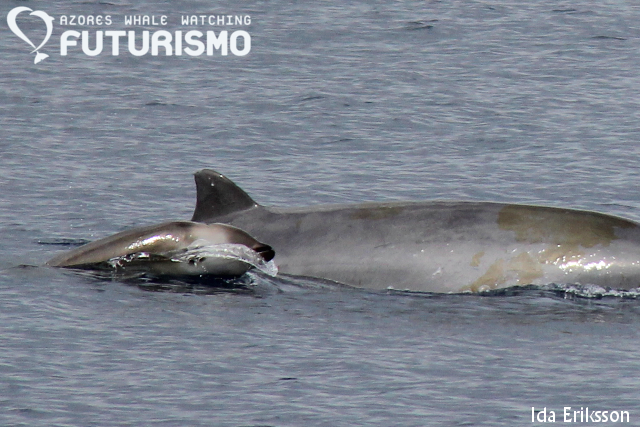
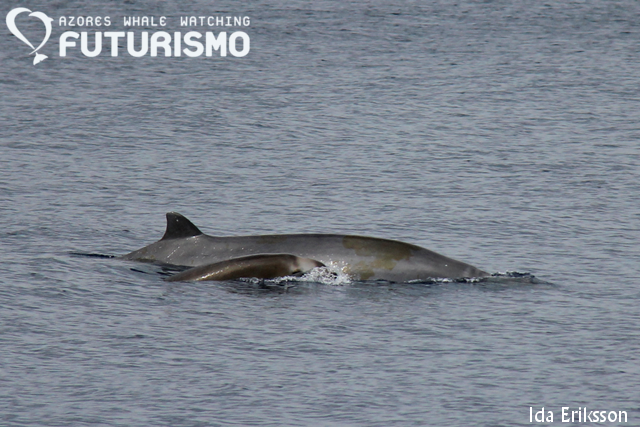
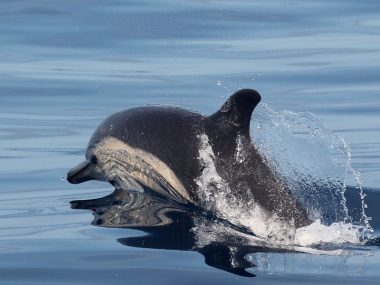
could be identified as True’s beaked whales and in 2012 we had a brief encounter. In 2015 we had a wonderful encounter with a female True’s beaked whale and her calf.
are found in two distinct populations in the cool temperate waters of the north
Atlantic and the southern hemisphere. It is not known if these two populations
are different species. As with other
beaked whale species, confirmed sightings in the Azores are rare, but they may
be present on a regular basis. In 2008 Futurismo had a rare close encounter with a small group that
could be identified as True’s beaked whales and in 2012 we had a brief encounter. In 2015 we had a wonderful encounter with a female True’s beaked whale and her calf.
Length:
• Male: 5.3 m
• Female: 5.4 m
• Calf: 2 – 2.5 m
Weight:
• Female: 1,400 kg
• Male: 1,010 kg
• Female: 1,400 kg
• Male: 1,010 kg
Global population: Unknown (population trend unknown)
Status: Data Deficient
Diet: Squid, fish
Teeth: 2 in the lower jaw (only males)
Longevity: Unknown
Breeding age: Unknown
Gestation: Unknown
Nursing: Unknown
In other languages
Portuguese: Baleia-de-bico-de-True
Spanish: Zifio de True
French: Baleine à bec de True
Italian: Mesoplodonte di True
Italian: Mesoplodonte di True
German: True-Schnabelwal, True-Wal, True-Zweizahnwal
Dutch: Spitssnuitdolfijn van True, True’s spitssnuitdolfijn
Swedish: Trues näbbval
Norwegian: –
Dutch: Spitssnuitdolfijn van True, True’s spitssnuitdolfijn
Swedish: Trues näbbval
Norwegian: –
Danish: Trues næbhvalen
Finnish: –


Polish: –
Russian: –


 Equipa de Biólogos da Futurismo



 Sandrina Rodrigues
