


 Equipa de Biólogos da Futurismo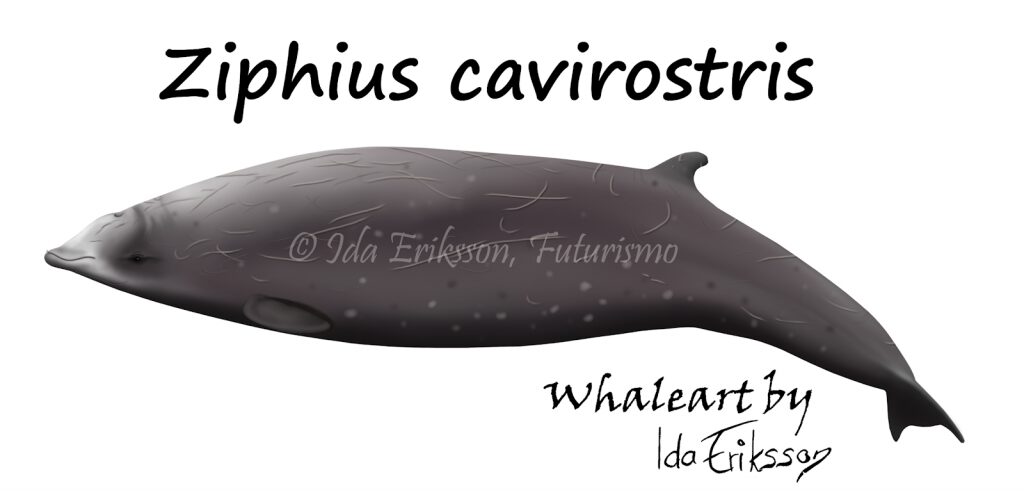
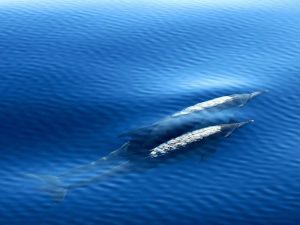
Cuvier’s beaked
whales are the among the most widely distributed of all the beaked whales. As
with other beaked whale species, they dive to great depths to
feed on squid. In fact in a study conducted in 2014 they were recognised as the deepest diving animals in the world, with a record that exceeds that of the sperm whale which was the previous record holder. In the study a tag was attached to a Cuvier’s beaked whale, which went down to a depth of 2,992 m. When diving the small flippers are tucked into the ‘flipper pockets’ and, like other beaked whales, there is no middle notch on the fluke. At the surface, they may be distinguished from other beaked whales by their relatively short beak and robust body. They prefer areas where
the water is deep very close to shore, such as around the islands of the
Azores. They are thought to be fairly common around here, but are not seen
often because they are difficult to observe at the surface. This is normally
the case for beaked whales that spend little time at the surface (as little as
8% of their life) and are very shy and elusive. Cuvier’s beaked whales may be seen alone or in small
groups of about 2 – 7 individuals. Little is known about their social habits
because as with other beaked whale species they are difficult to study in the
wild.
Length:
• Male: 6.9 m
• Female: 5.5 m
• Calf: 2.7 m
Weight:
• Male: 3,000 kg
• Calf: 250 – 270 kg
Global population: c.100,000 (population trend unknown)
Status: Least Concern
Diet: Squid, fish, crustaceans
Teeth: 2 in the lower jaw (only males)
Longevity: 25 – 35 years
Breeding age: Unknown
Gestation: Unknown
Nursing: Unknown
In other languages
Italian: Zifio
Dutch: Dolfijn van Cuvier
Swedish: Småhuvudval, Cuviers näbbval
Norwegian: Gåsenebbhval
Finnish: Hanhennokkavalas, cuvierinvalas
Russian:

 Equipa de Biólogos da Futurismo


 Sandrina Rodrigues
