


 Futurismo Biologists Team
How we cataloged Risso’s dolphins in Azores and why they have mark types more than other species
Risso’s dolphins (Grampus griseus)

The Risso’s dolphin (Grampus griseus) is a resident species in the Azores. They can measure up to 4 meters in length and weigh over 500 kg. In this species the length of females tends to be roughly the same as males, contrary to the majority dolphin species in which males are larger than females.
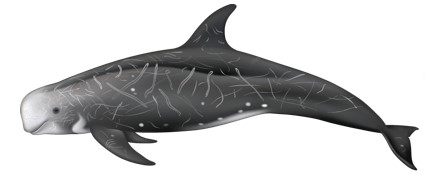
This species normally occurs in oceanic waters (400 m – 1000 m depth) and in temperate and tropical areas. They have a blunt head without a defined snout, which is an evolutionary morphological adaptation that facilitates their predation on squids and small cephalopods.
They have the peculiarity of being born with a dark colouration and acquiring marks throughout their lifetime, thus becoming white with age.


These marks can be caused by suction cups that squids have on their tentacles and by other Risso’s dolphins, since they can sometimes be more aggressive while socializing.
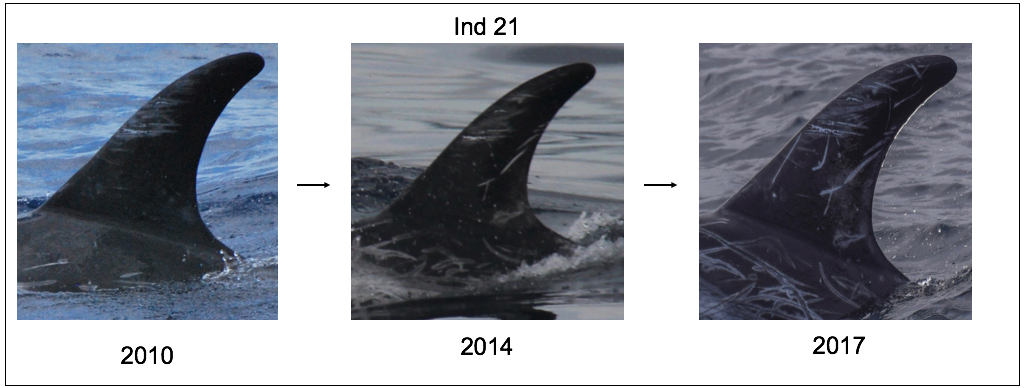
The photo ID is a technique used to identify individuals through a photo of their dorsal fin that can changes as the animal ages, acquiring marks and cuts. Since each dorsal fin is different then it works as a fingerprint and allows to create a individuals catalog.
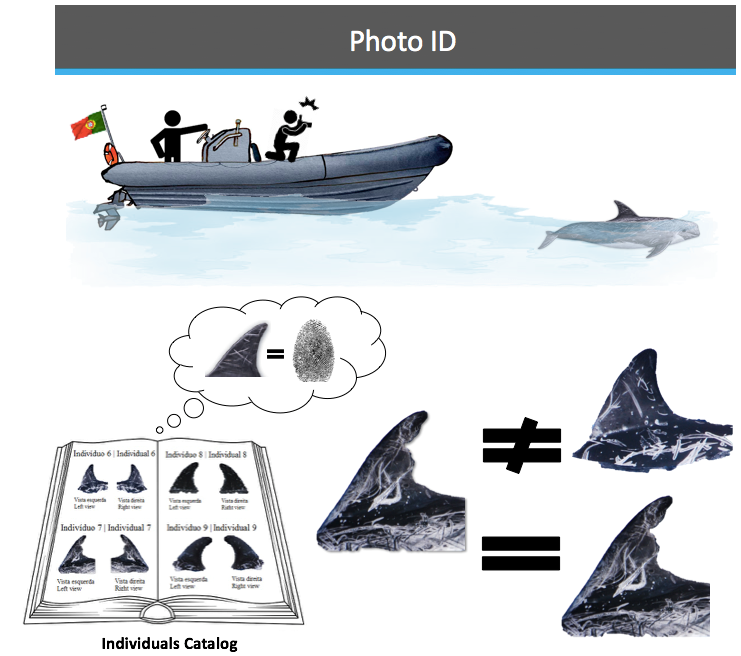
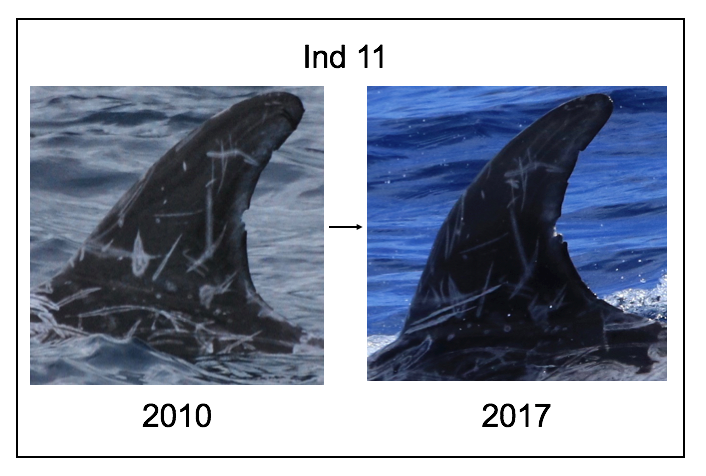
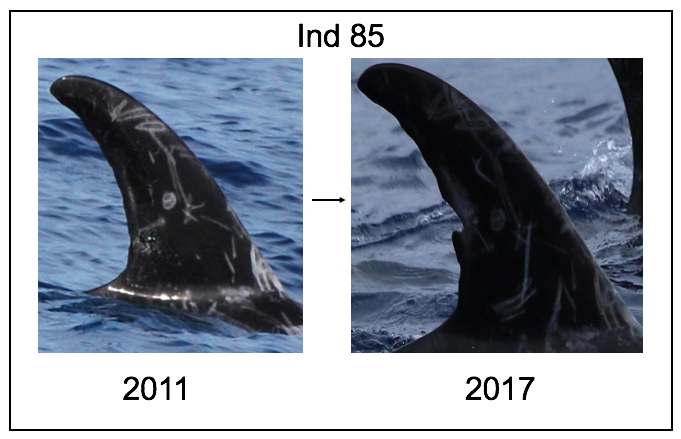
In Futurismo’s catalog are cataloged 570 individuals and 1100 photos taken since 2010. Here are some examples of some individuals who have many differences over the years:
Unfortunately, this species suffers greatly in terms of captivity, mostly in Asia. In Japan, hundreds of dolphins are caught every year. Those with better morphological conditions are trained for entertainment shows and the rest are killed. Do not contribute to these captive centers, it is much better to see the animals in their natural habitat. Do not buy a ticket!

Bibliography
Hartman, K.L., Visser, F. and Hendriks A. J. E. 2008. Social structure of Risso’s dolphins (Grampus griseus) at the Azores: a stratified community based on highly associated social units. Canadian Journal of Zoology 86(4): 294-306, April.
Hartman, K.L., Fernandez, M. and Azevedo J.M.N. (2014). Spatial segregation of calving and nursing Risso’s dolphins (Grampus griseus) in the Azores, and its conservation implications. Marine Biology, 161(6): 1419-1428.
Hartman, K.L., Fernandez, M., Wittich, A. and Azevedo, J.M.N. (2015b). Sex differences in residency patterns of Risso’s dolphins (Grampus griseus) in the Azores: causes and management implications. Marine Mammal Science, 31(3): 1153–1167.
Hartman, K.L., Wittich, A., Cai, J.J., van der Meulen, F. and Azevedo, J. M.N. (2016). Estimating the age of Risso’s dolphins (Grampus griseus) based on skin appearance. Journal of Mammology. 97 (2): 490-502.
Wursig, B. and Jefferson, T.A., (1990). Methods of photo-identification for small cetaceans. Report to the International Whaling Commission, Special Issue, 12: 43-52.
Written by Rafael Martins


 Futurismo Biologists Team


 Sandrina Rodrigues
